|
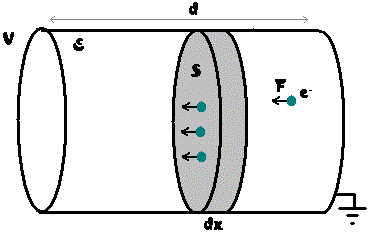
Imagining the free electrons of the band of
conduction of a conductor like an electron gas
(Drude's model), these move fastly inside the
conductor. |
![]() |
Creating a potential difference inside the solid we created and electric field
he electrons are accelerated by a force
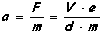
and according to the second principle of dynamics the acceleration is
In the model of perfect gases, here applied to electrons, the volumes are consider null and so they moves in an empty place; but the electrons are in an atmosphere where the other same elestrons are present, therefore they are taken place hits between atoms, where nucleus absorb the cinetic energy of the electrons, energy that will come converted in thermal (called Joule's effect). The drift speed that one that allows the passage of current from a smaller to a bigger potential
Applying the model of dynamics of the fluid we obtains
the loads results as
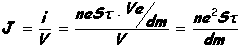
The density of loads that it will be directed in the same direction of the current is
the product of constants at the second member is calle RESISTANCE
measured in Ω. This expression represents the first law of Ohm the current that slides through conductor is always directly proporzional to the potential difference applied to the same instrument it can be indicated resistivity
this is the second Ohm's law
in the conductors the resistance it depends on the geometric configuration of the conductor and from the material of which it is constituted |


|
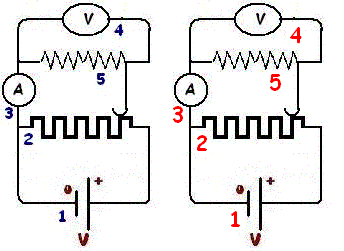
In order to verify the Ohm's laws it is necessary to compose a circuit composed by
|
|

Analyzing vary cases, we consider thesensibility of the scale of amperometer as 0,05 A and that one of the voltmetro as 0,02V
| V (Volt) | 4.0 | 3.5 | 3.0 | 2.5 | 2.0 | 1.5 | 1.0 | 0.5 |
|---|---|---|---|---|---|---|---|---|
| i (Ampere) | 1.6 | 1.4 | 1.2 | 1.0 | 0.8 | 0.6 | 0.4 | 0.2 |
R=2.5 Ω
| V (Volt) | 5.1 | 4.0 | 3.0 | 2.5 | 2.0 | 1.0 |
|---|---|---|---|---|---|---|
| i (Ampere) | 1.6 | 1.3 | 1.1 | 0.8 | 0.6 | 0.3 |
R=(3.2±0.1)
| V (Volt) | 5.0 | 4.0 | 3.0 | 2.0 | 1.0 |
|---|---|---|---|---|---|
| i (Ampere) | 1.7 | 1.35 | 1.0 | 0.7 | 0.35 |
R=(2.8±0.2)
| V (Volt) | 5.1 | 4.0 | 3.0 | 2.0 |
|---|---|---|---|---|
| i (Ampere) | 0.85 | 0.65 | 0.4 | 0.25 |
R=(7±1)
| V (Volt) | 5.1 | 4.0 | 3.0 | 2.0 | 1.0 |
|---|---|---|---|---|---|
| i (Ampere) | 0.85 | 0.65 | 0.5 | 0.35 | 0.15 |
R=(6.1±0.3)
| V (Volt) | 1.30 | 1.00 | 0.75 | 0.50 | 0.25 |
|---|---|---|---|---|---|
| i (Ampere) | 0.95 | 0.75 | 0.55 | 0.4 | 0.2 |
R=(1.4±0.1)